Scout of the "Gray Ranks", participant of the Warsaw Uprising, founder of the youth clandestine organization "Orlęce Oddziały Bojowe" in Jelenia Góra in 1949.
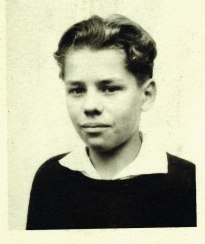
Son of Aleksander and Helena (née Turlińska). Before the war, Aleksander Chyliński worked as a bank clerk, then as the manager of the “Pod Giewontem” Hotel, and after the war as the head of the Academic Health Center “Odrodzenie” in Zakopane. In 1945 he moved to Lower Silesia and settled in Wleń. He worked as a fishing inspector at the Land Office in Cieplice, and from 1949 he was the manager of the “Leśny Dwór” Holiday Home in Wleń. A member of the Polish Socialist Party and later the Polish United Workers’ Party, he was nevertheless criticized by the County Committee of the PZPR as a man who surrounded himself with people “…not connected with our government…”. He died suddenly in 1954.
Antoni Chyliński lived in Warsaw and Zakopane until 1945. In the capital of the Polish mountains he was a student at the “School of the Grunwald Eaglets,” which was transferred to Karpacz in 1946. In the summer of 1946 he moved with his parents to Wleń, South Housing Estate no. 5.
He grew up in an atmosphere of deep patriotism and religiosity. His two older brothers, Janusz and Jerzy, were soldiers of the Home Army; both died in the Warsaw Uprising (during the fighting for the city center). In 1943 Antoni Chyliński joined the ranks of underground scouting movement (the “Zawisza” troop), where he operated under the pseudonym “Świstak” (“Marmot”). He took part in “minor sabotage” activities in Warsaw (painting slogans and symbols of the Polish Underground State on walls). During the uprising his task was to deliver food to the fighters. His attitudes and beliefs were also strongly influenced by contact with the nationalist movement during the occupation. Independence and national ideas were further reinforced by his attendance at the “School of the Grunwald Eaglets,” organized along military lines (divided into platoons, squads, and patrols), which educated young people who during the war had belonged to various underground formations, including nationalists. In June 1946 the school was dissolved and replaced by the Tadeusz Kościuszko Educational Center subordinated to the Society of Children’s Friends (Social Welfare Society) (TPD). Opinions about Chyliński at school and in his place of residence were positive; he was described as a “polite and courteous” person whose behavior at school was beyond reproach. Weak progress in the exact sciences was noted, while he performed much better in the humanities. In the opinion of the school board of the Union of Polish Youth (ZMP), he was “…of democratic political views, but not very positively disposed toward the present reality…”.
From September 1946 he was a student in the second year of the Stefan Żeromski Junior High School in Jelenia Góra. Already at that time he wanted to organize a group of peers around him; he led to one meeting in Wleń, but nothing came of it. The creation of a secret youth organization called the “Eaglet Combat Units” (Orlęce Oddziały Bojowe, OOB) took place only at the beginning of 1949. Its members were students of Jelenia Góra schools: Remigiusz Ziółek (alias “Mały”), Roman Gerhardt (alias “Romeo”), Lesław Fedzin (alias “Duży”), Zbigniew Dymecki (alias “Kruk”), Dżefar Radkiewicz (alias “Franek”), Andrzej Kowalczuk (alias “Sowizdrzał”), Jan Serafin (alias “Kruk”), Jerzy Witkowski (alias “Varda”), and Ryszard Turowski. The oldest of them, Ziółek, was 20 years old; the youngest, Serafin, was 14.
The task of the organization was to fight the political system imposed on Poland and to defend the Catholic Church against repression. From mid-1947 the communist authorities began the process of Stalinization of Poland in the economic sphere (liquidation of private ownership in trade and crafts, collectivization), political sphere (creation of the Polish United Workers’ Party (PZPR), forced unification of youth organizations and parties), and social sphere (atheization of society, repression of the Church and former members of the independence underground). Members of the OOB wanted to fight by distributing leaflets and through self-education activities (meetings to discuss current events, organizing anniversary commemorations, e.g., May 3 and November 11). Leaflets were posted in Jelenia Góra, Kowary, and Wleń. The idea of carrying out robberies to obtain funds for further activity (purchase of a printing machine) was abandoned as too risky. Instead, members contributed voluntary sums of money, with which a small hand-operated printer with rubber fonts was purchased. Chyliński divided the organization into three patrols (Jelenia Góra, Kowary, and a security and intelligence patrol), whose members collected information, among other things, about the uranium mine located in Kowary.
The organization was exposed by accident in October 1949, when a member of the school branch of the Union of Polish Youth found in the calendar of one of the conspirators a handwritten order by “Świstak” stamped with the “OOB” seal. He passed the find to the ZMP chairman, Julian Sobota. That same day a leaflet bearing Chyliński’s name reached the City Committee of the PZPR and then the District Public Security Office in Jelenia Góra.
Antoni Chyliński was arrested on October 31; further arrests followed on November 2 and 23. The investigation was conducted by the investigating officer of the District Public Security Office in Jelenia Góra, Second Lieutenant Stanisław Dusza, under the supervision of the head of the Voivodeship Public Security Office in Wrocław, Lieutenant Colonel Jan Zabawski, and was concluded on February 4, 1950. The trial of the OOB members before the Military District Court in Wrocław, held in an away session in Jelenia Góra, began on May 15, 1950. The trial was a show trial, attended by students from schools in Jelenia Góra and the surrounding area. During the proceedings, Chyliński tried to take all the blame upon himself, minimizing the involvement of the other defendants. On May 17, 1950, the military judge, Captain Zygmunt Kubrycht, found Antoni Chyliński guilty of membership in an illegal club of the National Party on school grounds, attempting to remove state authorities and violently change the political system, possession of firearms, and ordering the collection of information constituting a state secret (the Kowary Mines), and sentenced him to eight years in prison.
Antoni Chyliński was imprisoned in Jelenia Góra prison. On September 22, 1950, after sawing through the bars of a window overlooking the prison yard, he took part in an escape attempt. Chyliński was transferred to the Central Prison in Rawicz. He served the remainder of his sentence in Jaworzno, Prison No. 1 in Wrocław (held in an isolation ward), and from November 13, 1954, in Barczewo. Imprisonment did not break him; in the assessment of prison authorities he was hostile toward the USSR and the political system in Poland, showed no remorse, and was punished for “…spreading hostile propaganda about the fighting in Korea…”. The warden of the prison in Barczewo wrote in the inmate’s profile that despite five years of imprisonment, “…in a conversation conducted with him regarding conditional release for good behavior, he stated that he did not want any clemency…”. Moreover, he told other prisoners that the Soviet Union was occupying Poland and taking everything from it, and that there were no democratic freedoms in Poland.
Letters requesting his release were repeatedly sent to party and judicial authorities by his mother and by Roman Gerhardt. By decision of the Military District Court in Wrocław of May 5, 1955, Antoni Chyliński was conditionally released from the remainder of his sentence for a probation period lasting until November 2, 1957. He left the prison in Barczewo on May 7, 1955, at the age of 24. He did not return to Jelenia Góra; he settled in Koluszki and later in Łódź, living at 22/2 Pojezierska Street. He worked for the Polish Angling Association, managing the Łódź Branch.