Teacher, Pedagogue.
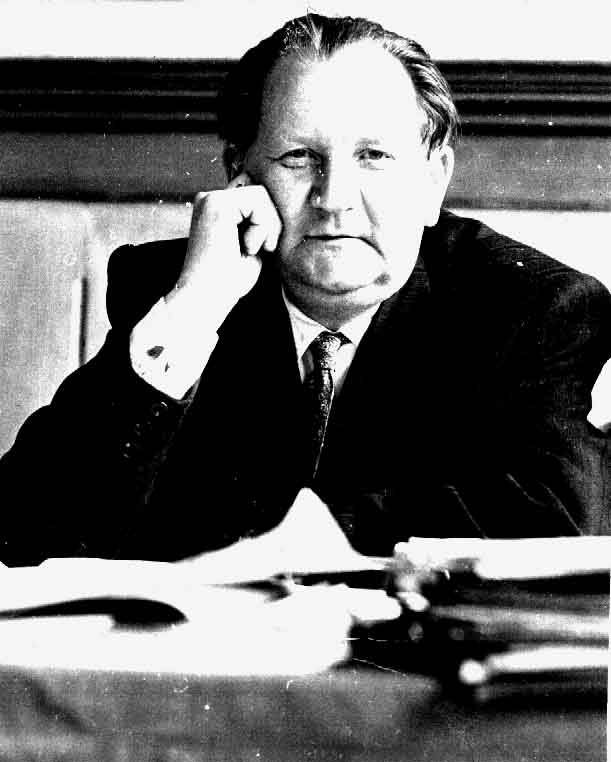
Antoni Dynowski – teacher of economics, headmaster of the School of Economics in Jelenia Góra.
He was born in 1902 in Przeworsk. In 1929, he graduated from the Faculty of Pedagogy at the Higher School of Commerce in Kraków; in 1939 he received a diploma from the Academy of Commerce in Kraków. He began teaching in 1929 at the Commercial School in Kołomyja, continuing his work at the Commercial High Schools in Brody, Sokal, and Żywiec. Between 1929 and 1939, alternately with his teaching positions, he worked as an accountant, court expert, manager of the DOKP offices in Warsaw, in railway operations in Przeworsk, and in other institutions.
Beginning in early 1947, he taught vocational subjects at the former Commercial Junior High School and High School in Jelenia Góra. From 1947 to 1957 he served as deputy headmaster, and from 1957 to 1965 he held the position of school principal. After the tragic death of his wife, he returned to his hometown of Przeworsk; for seven years he worked as a German language teacher in Rzeszów. He died in 1972. He worked at ZSE-T for 19 years and in the teaching profession for 30 years.
Antoni Dynowski was awarded the Gold Cross of Merit, the Knight’s Cross of the Order of Polonia Restituta, and the Badge of Merit for Lower Silesia
As a teacher and principal, he cared deeply about the high standard of vocational education and achieved excellent results in teaching corporate accounting. He owed these successes to his remarkable memory and natural sharpness of mind (It was astonishing how quickly he could add long columns of numbers).
His long professional experience allowed him to incorporate the essential needs of corporate economic services into his teaching while staying up to date with internal departmental regulations. He actively participated in the work of the Polish Economic Society and the Association of Accountants in Poland.
He placed great emphasis on the matura exam as the most important test of both vocational and general preparation. His accounting topics for written matura exams, which required knowledge, skill, and precise reasoning, became famous in Wrocław. Although he specialized in economic subjects, he also demonstrated an excellent command of the humanities and often read all the Polish language essays. He was particularly sensitive to linguistic correctness and clarity. He knew the works of Polish classical authors very well. (When, during an exam, a student struggled to recall who hosted the big-game hunting parties in Pan Tadeusz, he helped by quoting: “If you, bear, were sitting in your den…”)
He was a man of tireless work: he often finished exams and meetings late in the evening; at night he corrected lengthy student essays and prepared topics. He helped tutors fill out high school diplomas, assigned himself as class teacher to be “closer to the student”, and spent time after lessons talking and consulting them. In this way, he fostered an atmosphere of educational engagement and the belief that only through persistent and difficult effort can true academic success be achieved. He advocated the principle that nurturing is superior to “pure didactics,” which proved especially effective while working with adolescents, manifested through warm, informal gatherings.
Consequently, he achieved many individual educational successes, particularly through his kind approach to difficult students [1]. He showed special concern for physically disabled, poor, or neglected children—not out of pedagogical obligation, but from a natural sensitivity to human fate. He expected a lot from his students, striving to prepare them well for their profession, yet he always supported them with patient encouragement and helped them overcome difficulties.
Remarkably—perhaps even on a national scale—he maintained friendships with entire cohorts of students. He became friends, among others, with all graduates of 1949 and 1950, maintaining these relationships for over 20 years until his death; afterward, the friendship was continued by his brother, Kazimierz Dynowski, himself a teacher at the Commercial Gymnasium and High School in 1947–1953.
He addressed younger teachers with kind, nurturing respect and believed that understanding youth and readiness to work beyond assigned duties were the most important qualities in a teacher. For two decades, thanks to his strong personality, he exerted a profound influence on both the teaching staff and their pedagogical work, as well as on the student community. He was well known among the people of Jelenia Góra and within professional circles in Wrocław and Warsaw. His student, Krystyna Susabowska, a poet from Jelenia Góra, said: “He was an extraordinary person, an extraordinary personality. He did not belong to any political party, but through the dark waves and cliffs of the PRL era he led the youth toward the pure springs of their ancestral land, to the teachings of righteous and noble men.”