Painter, graphic artist, writer.
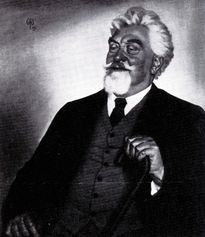
After studying at the Berlin Academy of Art, he quickly became a well-known portrait painter. At the end of the 19th century, as a professor at the Berlin Academy of Fine Arts and a painter to the Prussian royal court, he portrayed the most prominent figures of imperial Germany.
At the beginning of the 20th century, Fechner purchased a rural cottage in Middle Szklarska Poręba, located at 11 Dolna Street. Within a short time, he assembled an extensive collection of Silesian folk furniture. The interior of the house was described in the journal “Schlesien” in 1908 by A. Koeppen as follows:
“In the middle of the room stands an old chimney, against the wall a colorfully painted wardrobe, and as before the clock ticks its ‘tick-tock’ with its hanging weights. Of course, several alterations had to be made to the house so that the old barn could be turned into a bright painter’s studio.”
The painter named his house “Hagal,” meaning “Hege des All” – “Shelter for All.” The name Hagal also corresponded to a runic symbol associated with the goddess Hel.
As a result of a tragic accident in 1910, the painter partially lost his eyesight and eventually became completely blind. From this period comes one of the most moving portraits created by the artist, depicting his friend Wilhelm Bölsche. Bölsche’s figure is unfinished, rendered in a sketch-like manner and painted with flat patches of color, which was entirely unlike Fechner’s earlier, realistic style.
Hanns Fechner was an initiator and one of the founders of the “Schlesische Bund für Heimatspiele” (Silesian Association of Folk Theatres), which placed particular emphasis on preserving culture and regional dialect. The association was active in Silesia during the 1920s and brought together many amateur theatres. A local branch was established in Szklarska Poręba on September 28, 1919. Dr. A. Koeppen became its chairman, with Hanns Fechner as his deputy. The painter often served the theatre as a director, stage designer, scriptwriter, and at times even as an actor.
Hanns Fechner was also the originator and an honorary member of the “Künstlervereinigung St. Lukas in Ober-Schreiberhau” (St. Luke’s Artists’ Association in Upper Szklarska Poręba), known as the “Łukaszowcy,” which brought together painters whose work was inspired by the Karkonosze Mountains. Years later, one of the members recalled Fechner with these words:
“Master Fechner was our soul, the soul of our Brotherhood of St. Luke. He was entirely ours. His great love for art was, through art, a love for us.”
Fechner’s idea was to organize a festival in Szklarska Poręba called “Johanniswoche.” This event brought together resident artists and the inhabitants of the Karkonosze region in creative collaboration. The events, always held during the week of Midsummer’s Eve, included folk theatre performances, folklore group appearances, literary evenings, exhibitions of local crafts, painting vernissages, and various musical concerts took place. The culmination of these festivities was St. John’s Night, when dozens of bonfires were lit on the meadows around Szklarska Poręba as places of communal gatherings and celebrations (unless it rained, as in 1923). The week concluded with a colorful procession of participants in folk costumes, marching through the entire town.
Blind in his later years, Fechner dictated his memoirs of artistic life to his wife Hannah. In 1925 he published memoirs of his Berlin youth dedicated to his mother, titled “Spreehanns” (“Johnny from the Spree”), which he later continued in Mein liebes altes Berlin (“My Dear Old Berlin”). He created a beautiful collection of fairy tales and legends about the Karkonosze Mountain Spirit entitled Bergzauber (“Mountain Magic”). He wrote about the people he portrayed in the book Menschen, die ich malte (“People I Painted”), published in 1927 and dedicated: “To Hannah, my dear wife, my faithful guide along the final paths of life.” In the chapter devoted to his neighbor Carl Hauptmann, he wrote: “True people do not wear the mask of convention on their faces—they are always themselves.”
Hanns Fechner died on November 30, 1931, and was buried in the Evangelical cemetery in Lower Szklarska Poręba.